

Atom Model Rock Painting
- DifficultyMedium
- Ages8–14
- 35 min
Materials Needed
- Round or oval flat rock
- Black or dark navy acrylic paint (for background)
- White acrylic paint
- Teal or turquoise acrylic paint
- Gold or yellow acrylic paint
- Light blue acrylic paint
- Red acrylic paint
- Fine detail brush
- Medium flat brush
- Clear sealant spray
- Pencil (compass for drawing circular orbits)
Step-by-Step Instructions
-
Paint the dark background
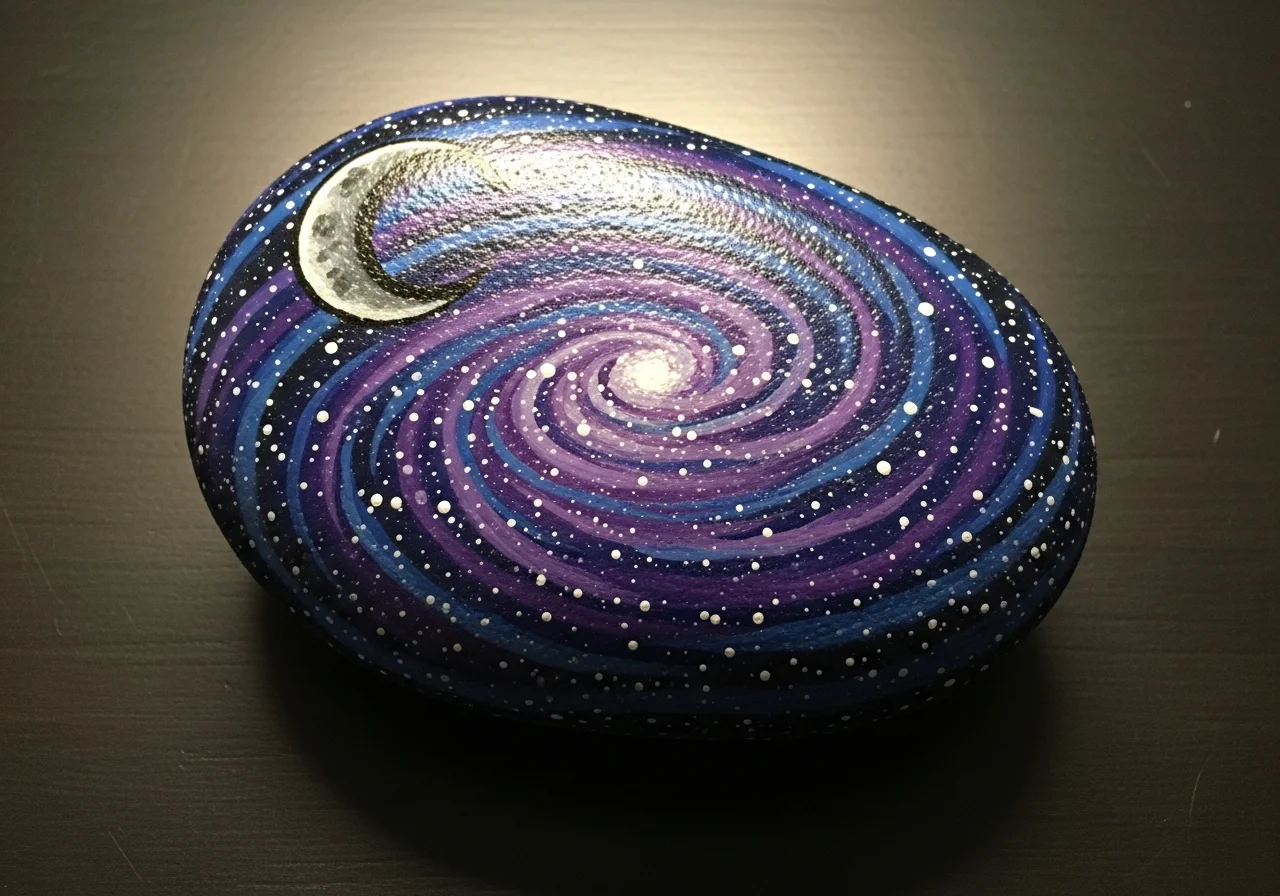
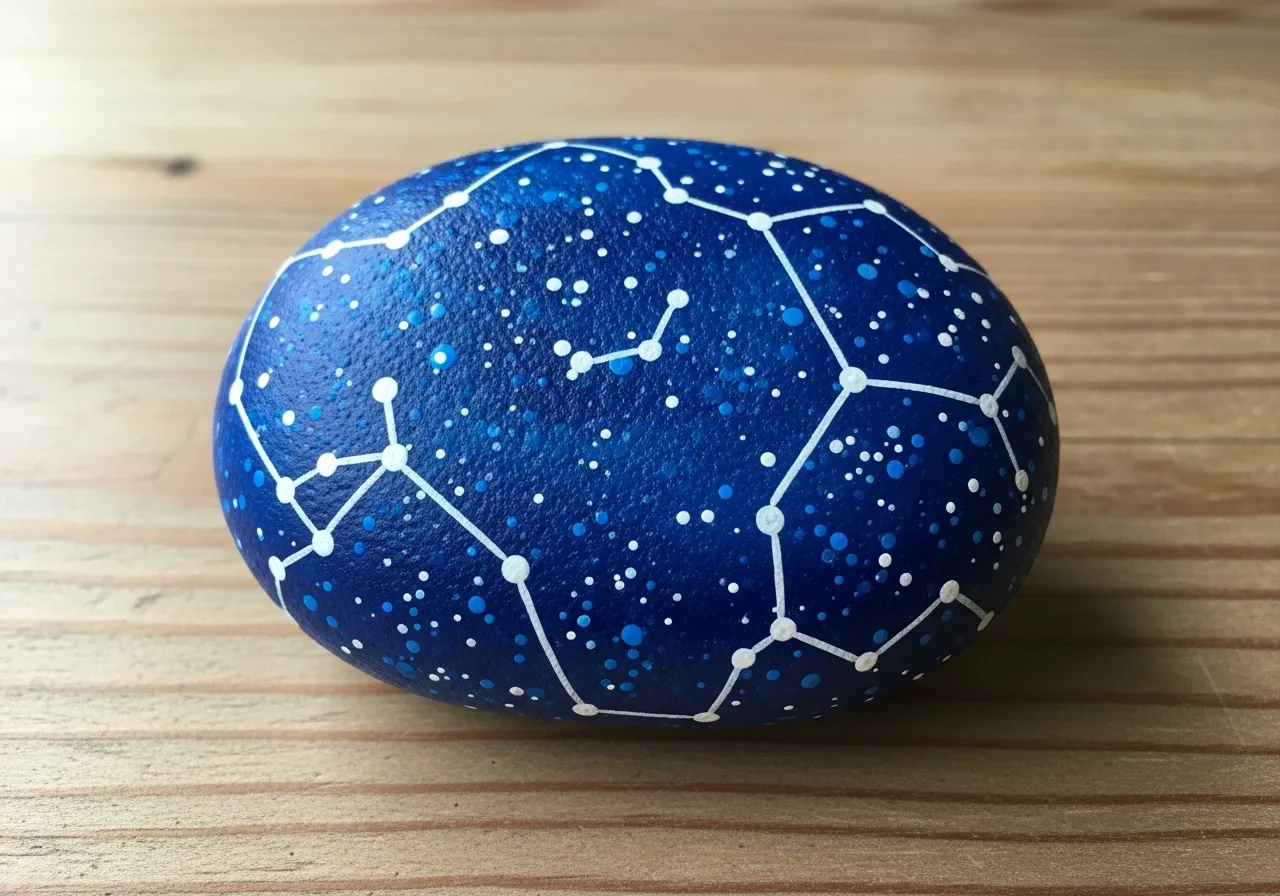
Wash and dry your rock. Paint the entire surface with deep navy blue or black. Tiny white dot stars can be added for a scientific-meets-cosmic feel. The dark background makes the glowing orbital lines and electrons stand out dramatically.
-
Draw and paint the nucleus
In the center of the rock, paint a cluster of tightly packed dots for the nucleus: some red (protons) and some white or gray (neutrons). The nucleus should be a dense, compact cluster suggesting the tight packing of nuclear particles. It should be notably smaller than the orbital rings around it.
-
Paint the electron orbital rings
Using teal or turquoise paint and a fine brush, paint two or three elliptical orbital rings around the nucleus at different angles. Each ring is a thin, complete ellipse. Like a gyroscope, the rings should be oriented differently - one horizontal, one tilted left, one tilted right - to create a three-dimensional spherical appearance.
-
Add the electrons
Paint one small bright yellow or gold dot on each orbital ring to represent an electron. Position them at different points along each ring - not all at the same angle. Each electron should glow slightly by adding a tiny white highlight dot inside the yellow dot.
-
Add glow effects and seal
Using very diluted white paint, add a soft glow halo around the nucleus. Add thin light-colored trailing lines behind each electron to suggest orbital movement. Apply clear sealant when fully dry for a polished finish on your atom model rock.
-
Add RoxGeo Code
On the bottom or back of your rock, write ROXGEO.COM followed by a slash and your rock’s unique code (e.g. ROXGEO.COM/ABC123). This lets the finder go directly to your rock’s profile page and log their discovery. If the rock is too small for the full address, write #ROX followed by the code without spaces (e.g. #ROXABC123) — it’s short, easy to search on Google, and leads straight to your rock’s journey page. Use a fine-tip permanent marker or acrylic paint pen, and seal it with clear varnish so the code stays readable through rain, sun, and adventure.
Helpful Tips
- Elliptical orbital rings at different angles create the three-dimensional atomic model effect.
- Red dots for protons and white-gray for neutrons are scientifically accurate and visually distinct.
- Glowing electron dots with a tiny white highlight look like particles of pure energy.
- A dark background is essential - it makes the teal orbital rings and glowing electrons pop.
- Atom model rocks are great for science fair projects and classroom displays.