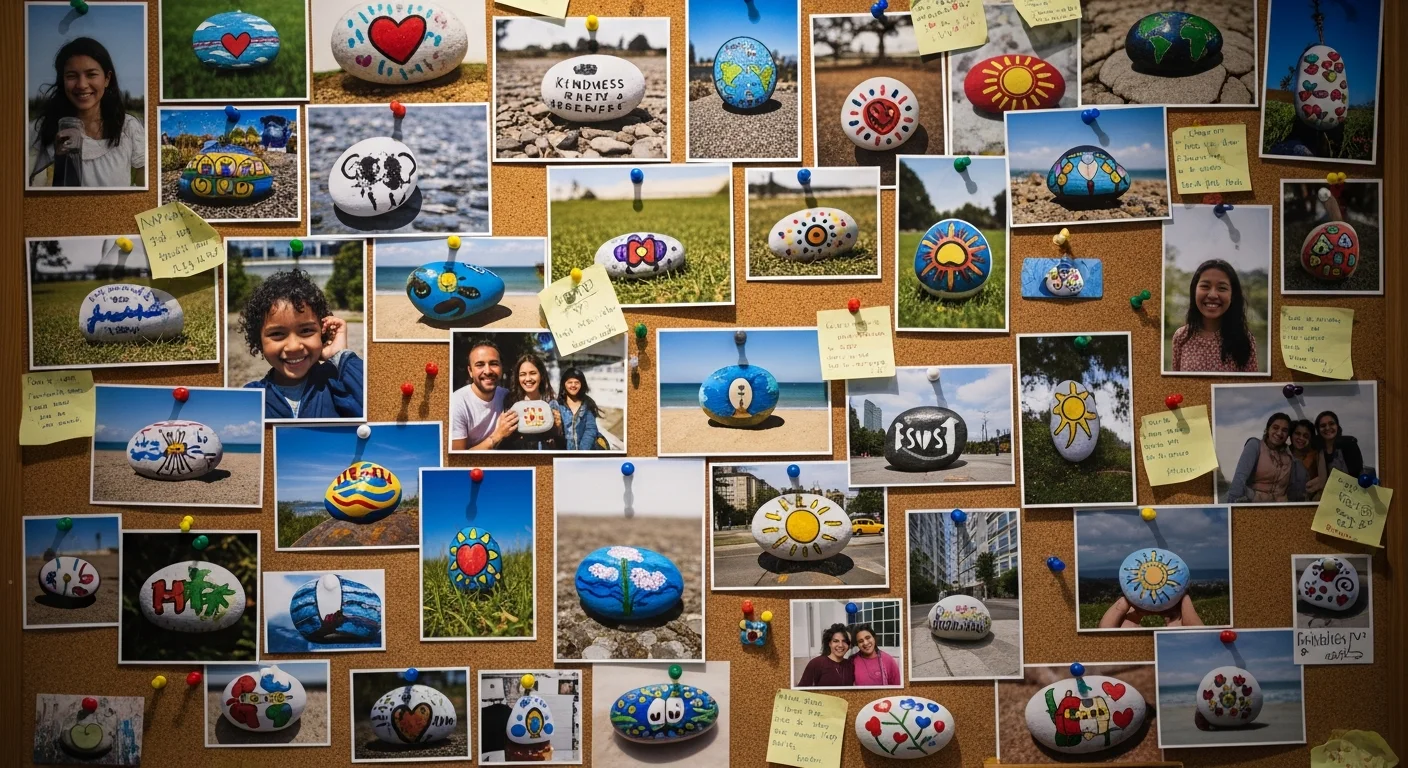

You take the dog out, sit down on a park bench, and next to you lies a small, colourful stone. Someone has painted a cathedral on it, or a ladybird, or the words “Smile”. You turn it over and see a postal code. This is how the adventure with kamyczki begins. It is the Polish painted-rock game, and almost a million people in Poland already play it.
“Kamyczki” (pronounced kah-MICH-kee) is Polish for “little pebbles”. In this guide we explain what painted kamyczki are, how the #kamyczki Facebook group works and why people write a postal code on the back of a rock. We also show how to add a RoxGeo code next to it, so you can see the whole journey of your rock on a map. You do not have to give up the group’s rules, because the two complement each other.
What are kamyczki? Painted rocks travelling across Poland
Kamyczki is a game of painting rocks and leaving them in public places: parks, trails, playgrounds, railway stations. The person who finds a rock can keep it, or move it and leave it for the next finder. What matters most is that a painted rock is a small gift for a stranger. Nobody knows who will find it or when.
The painted-rock movement has several roots. In 2015 in the United States, Megan Murphy began leaving rocks with kind words on the beaches of Cape Cod. That is how The Kindness Rocks Project started (read more in our article The Kindness Rocks Movement). The Polish #kamyczki group says its game was taken from Czechia, where painted “kamínky” became popular earlier (see also: painted rocks in Czechia and Slovakia). According to the administrators, over time the rocks simply became “carriers of joy passed selflessly to another person”.
Why are painted rocks so addictive? Because they combine several things at once:
- creativity: anyone can paint a rock, no talent required;
- time outdoors: looking for rocks is a reason to go for a walk;
- surprise, similar to treasure hunting or geocaching;
- community: a find ends with a post, comments and thanks from the author.
The #kamyczki Facebook group in numbers
The biggest home of Polish rock fans is the Facebook group “kamyczki – #KAMYCZKI grupa oryginalna”. It was created about 6 years ago and is still growing fast. At the end of 2024 the media wrote about more than 600,000 members. Today there are more than 900,000.

According to the group’s information from 3 November 2026:
- the group has 912,000 members, more than the population of Kraków;
- 734 new people joined in the last week;
- 178 new posts appeared in a single day;
- order is kept by 6 administrators and 11 moderators.
A community this big needs clear rules. Without them, thousands of posts a day would turn into chaos.
The #kamyczki group rules, step by step
The group’s rules are required reading before you paint your first rock. Below we summarise the most important ones. Always check the current rules in the group, because the administrators may change them.

How to publish a post about a rock you found
A post about a found rock gets approved quickly if it contains three things:
- The place where you found it, for example “Found in: Wrocław, Szczytnicki Park”.
- The postal code from the rock, written in the post text, for example 50-001 or 50001 (as it is written on the stone).
- One photo of the rock: the painted front, or a collage of several photos. More photos can go in the comments.
The collective post for rocks you leave behind
Rocks that you leave do not get a separate post. They go in the comments under the collective post pinned in the “Featured” tab. A new one appears every week.
Why there are no children in the photos
The photo in a post should show the painting on the rock. The group explicitly asks people not to publish images of children. It is a sensible rule: kamyczki are a family game, but a photo with the place of the find should not reveal where a particular child is playing.
What if you want to keep the rock?
You can. If the rock won you over, add a post and let the author know. As the administrators put it, the author will appreciate it and will very likely paint more rocks.
What the postal code on a rock is for, and where its limits are
A postal code on the back of a rock is a simple, clever solution. It says where the rock comes from, and the author can search the group for posts with their code to see whether someone has found their rock. It needs no app and no registration, just a marker.
It does have limits:
- A whole neighbourhood shares one postal code. Hundreds or thousands of rocks by different authors can carry the same code, so it is hard to tell which one is yours.
- The history is scattered. If a rock visits five cities, the information ends up in five different posts, often published months apart.
- There is no map. You cannot see the route the rock travelled in one place.
- The author only finds out if they happen to see the post. With 178 posts a day it is easy to miss one.
- You need a Facebook account. A finder who does not have one cannot let anyone know the rock has moved on.
This is exactly where a RoxGeo code helps.
RoxGeo codes: every rock with its own page, map and journey history
RoxGeo is an app and a website for people who love painted rocks. Every rock registered in RoxGeo gets a unique code. It does not replace the #kamyczki group rules: you add the RoxGeo code next to the postal code. We describe how it works in the article How painted rock tracking works with RoxGeo.
The #ROX code and the roxgeo.com address
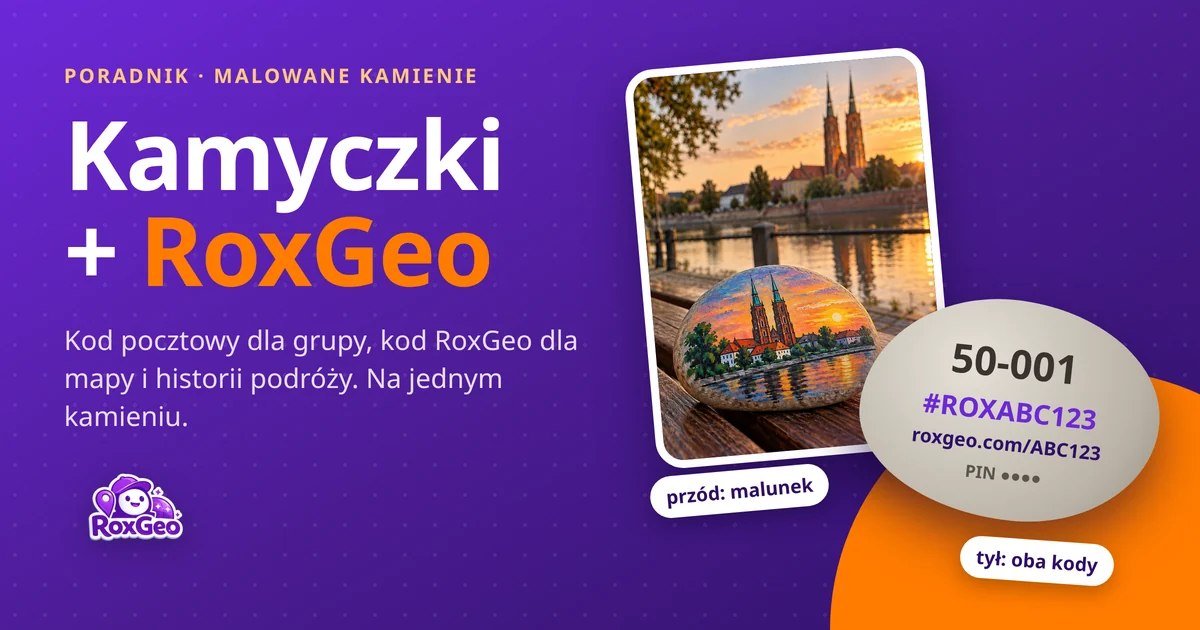
On the rock you write two parts of the same code:
- a hashtag, for example
#ROXABC123, which you can add to a social media post; - the rock’s page address, for example
roxgeo.com/ABC123, which the finder opens in their phone’s browser without installing the app.
One rock has one code. There is no risk that your rock gets mixed up with a neighbour’s rock from the same housing estate.
You can also add the rock’s address to your post in the #kamyczki group. Then anyone who sees the post can click the link and view the whole journey of the rock: the map, the stops and the number of finders.
The secret PIN: proof that someone held the rock
The back of the rock also carries a PIN. The finder enters it on the rock’s page, which confirms that they really found it and did not just see a photo online.
That is why there is one iron rule: you never share the PIN in a post, a comment or a photo. The rock’s address is public and you can share it. The PIN stays only for people who held the rock in their hands. This fits well with the group’s rules, because in a post you show the painted front of the rock anyway.
The map and the journey history
Every reported find is added to the history of the rock. On the rock’s page you can see where it was hidden and who found it, in order, on one timeline and on a map. A rock from Wrocław that ended up in Zakopane has its whole route in one place, not in five posts.
To be honest: this is not a GPS tracker. The map shows reported finds and hiding places, so the journey is visible when finders report it.
Notifications for the author
When someone reports finding your rock, you get a notification. You do not need to browse the group every day and search for your postal code.
The finder does not need an account
A find can be reported anonymously, or the finder can sign in with email, Google or Apple to stay in the rock’s history permanently and get notifications about its further journey. A Facebook account is not needed.
Postal code or RoxGeo code? A comparison
In short: the postal code connects the rock to the group, and the RoxGeo code gives it its own history. You gain the most when you have both.

| Feature | Postal code (#kamyczki rules) | RoxGeo code |
|---|---|---|
| What you write on the rock | for example 50-001 | #ROXABC123, roxgeo.com/ABC123 and a PIN |
| Uniqueness | the whole neighbourhood shares the same code | one rock, one code |
| Where you report a find | a post in the Facebook group | the rock’s page or the app |
| Account needed | yes, on Facebook | no, a report can be anonymous |
| Journey history | scattered across posts | one timeline |
| Map | none | a map of finds and hiding places |
| Notification for the author | only if they come across the post | on every find |
| Proof of the find | a photo | the PIN from the back of the rock |
| Reach | a Polish Facebook group | many languages, a page in Google within hours |
| Biggest strength | a huge, kind community | a lasting trace of the journey, also abroad |
Two systems side by side: the #kamyczki group and RoxGeo
The #kamyczki group and RoxGeo do not compete. Each does something different, and on one rock they work together without conflict.
The #kamyczki group gives you:
- a huge, kind community that watches, comments and says thank you;
- a postal code by which the author recognises their rocks;
- posts about finds and a weekly collective post for the rocks left behind.
RoxGeo adds:
- a unique code and a page for the rock, for example
roxgeo.com/ABC123; - a map and a journey history in one place;
- notifications for the author and confirmation of a find with a PIN;
- access without Facebook, in many languages, with a result in Google.
What connects them: the same rock and the same post. In the group post you write the postal code and the place and add a photo, as the rules require. On top of that you add the hashtag #ROXABC123 and the address roxgeo.com/ABC123. The group has its post, and the rock has its history. The only thing you do not share is the PIN.

How to combine the #kamyczki rules with RoxGeo, step by step
Following the #kamyczki group rules does not rule out using RoxGeo. They are two different tools: the group gives you a community and the joy of browsing rocks together, and RoxGeo gives you a map and a history. Here is how to combine them.
How to mark the back of a rock
- Paint the rock and wait for the paint to dry.
- Register the rock in the RoxGeo app. You get a code, a page address and a PIN. We describe the first rock step by step in How to set up your first tracked rock with RoxGeo.
- Write the postal code on the back, as the group’s rules require, for example 50-001.
- Add the RoxGeo code underneath:
#ROXABC123androxgeo.com/ABC123. - Add the PIN, preferably in smaller characters, at the bottom.
- Seal everything with varnish so the writing survives rain and being passed from hand to hand.

Tip: write the codes with a thin acrylic marker or a thin brush. Use clear, printed letters so that “0” and “O” or “1” and “I” are not confused.
You found a rock with a #ROX code? What next
If the back of the rock carries both a postal code and a RoxGeo code, do two things. Both take about a minute.
A. Publish a post in the #kamyczki group using the template from the next section: postal code, place, one photo, plus the #ROX hashtag and the rock’s address.
B. Report the find on the rock’s page:
- Type the address from the rock into your browser, for example
roxgeo.com/ABC123. - Enter the PIN from the back of the rock.
- Report the find anonymously, or with email, Google or Apple.
The author gets a notification, and your find appears in the rock’s history. Then leave the rock in a new place and add it to the group’s collective post.
A post template for the #kamyczki group with the rock’s address
Below are two ready-made templates that follow the #kamyczki group rules. Copy one, change the details and paste it. The group works in Polish, so the templates are in Polish. Remember one photo of the front of the rock (or a collage), with no children in the picture.
Template 1: a post about a rock you found
Kod pocztowy: 50-001
Znaleziony w: Wrocław, Ostrów Tumski

Kamyczek ma kod RoxGeo #ROXABC123.
Jego podróż możecie zobaczyć tutaj: roxgeo.com/ABC123

Dziękuję autorowi! Kamyczek rusza dalej 💜
Add one photo of the front of the rock to the post.
Template 2: a comment in the collective post about a rock you left
Zostawiony w: Kraków, Planty, ławka przy Barbakanie
Kod pocztowy: 50-001
#ROXABC123, podróż: roxgeo.com/ABC123
What not to put in the post
- The PIN. Never. We do not write it in a post, a comment or a message, and we do not show it in a photo. If you upload a collage of both sides of the rock, cover the PIN.
- Images of children. The photo should show the painting on the rock.
The postal code and the place are for the group. The hashtag and the address are for anyone who wants to see the rock’s journey. The PIN is only for the finder.

A rock’s journey on the map: what you get
The most beautiful thing about kamyczki is that you do not know where they will end up. A rock left in Wrocław may travel with a tourist to Opole, then Katowice, Kraków and finally Zakopane. With a postal code alone you will learn at most about single stops, if you happen to come across the posts.
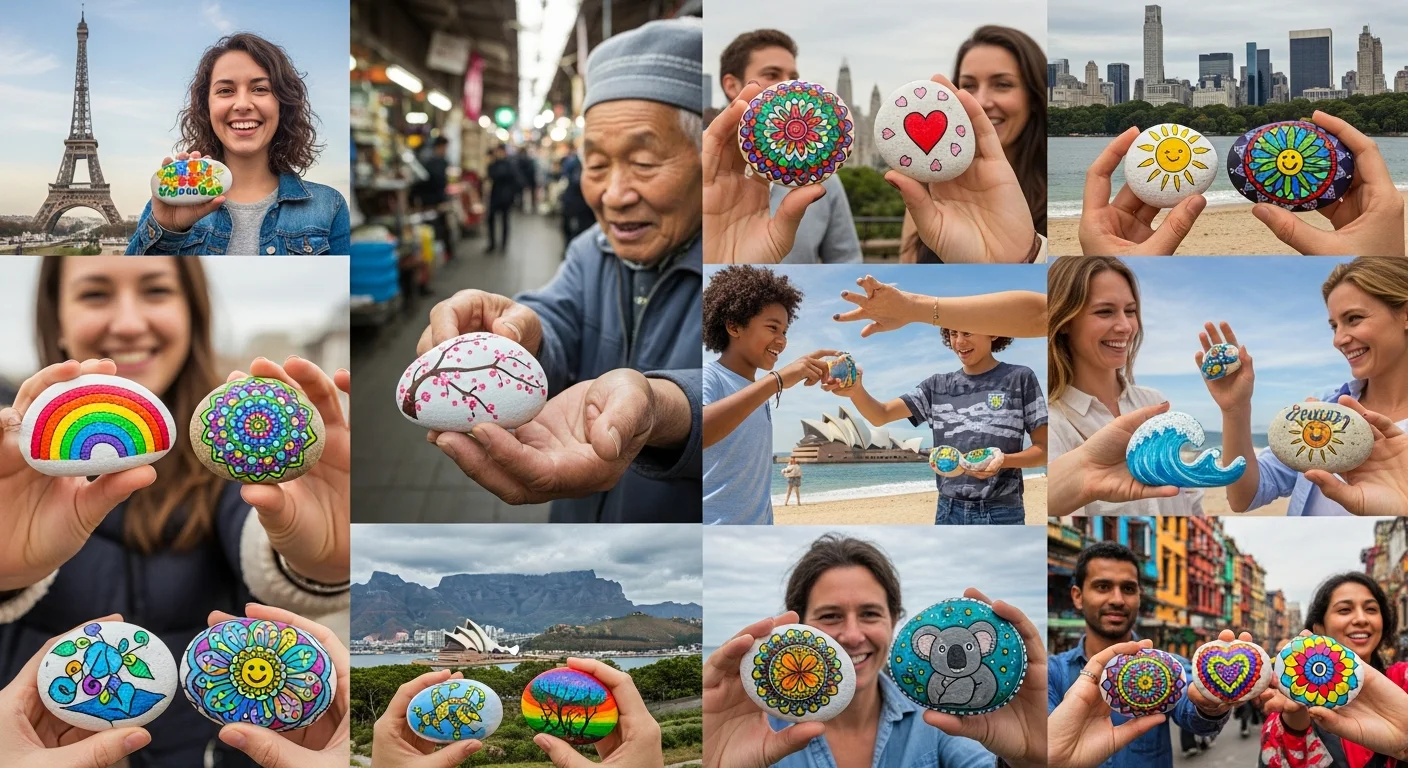
With a RoxGeo code every reported stop is added to the map. You see the route, the dates and the number of finders. For the author it is a great satisfaction. For children it is a geography lesson in which their own rock chooses the route. Real travel stories are in How painted rocks travel the world.

Rocks without borders: RoxGeo in many languages and in Google
Rocks travel further than you think. A tourist from Germany takes a rock from the Karkonosze mountains to Dresden, and a family from Czechia finds it on the Baltic coast. That finder does not belong to the Polish group, does not know the postal codes and often has no Facebook. A postal code alone will tell them very little.
A RoxGeo code works the same way in every country:
- Many languages. RoxGeo works in many languages. A finder from Germany, Czechia, Ukraine or Italy sees the rock’s page in their own language.
- A Google result within hours. The page of a rock with a unique #ROX code usually reaches Google within a few hours of registration. The code is unique, so when you type
#ROXABC123into a search engine, the rock’s page usually appears in first position. - No Facebook. The finder does not need a Facebook or RoxGeo account to see the rock’s journey.
- Joining the history. It is enough to enter the PIN from the back of the rock to mark yourself as a finder: anonymously, or with email, Google or Apple.
Thanks to this, a rock from the Polish group can collect new stops from all over Europe, and the author finds out about them from a notification.

How to paint rocks that survive the journey
A few proven rules that keep painted rocks looking good for a long time and keep the game kind to nature. If you are just starting, see the beginner’s guide and the list of essential supplies.
- Choose a smooth rock, preferably flat and the size of your palm. Wash it and dry it.
- Paint with acrylic paints or acrylic markers. On dark rocks a white base coat works well.
- Seal the rock with varnish, preferably a clear acrylic varnish for outdoor use (sealer comparison). Without varnish the paint and the codes wear off quickly.
- Do not glue on glitter, plastic eyes or stickers. They fall off and stay in nature.
- Do not take rocks from protected places, such as national parks and nature reserves, and do not leave rocks there.
- Leave rocks in public, safe places: not on the road, not on railway tracks, not on private property and not where they could get in the way of a lawn mower (where to hide painted rocks).
- Write the codes clearly and leave room for them on the back of the rock at the design stage.
Kamyczki for children, families and schools
Painting rocks is one of the simplest ideas for time with children. You need a few rocks, some paint and an afternoon. Then comes the best part: a walk, choosing a hiding place and waiting to see whether someone finds the rock. For weekend ideas see Family rock painting for every weekend, and for the safety of paints and play see the guide for families.
A RoxGeo code adds something children love to this game: a sequel. Instead of “I wonder what happened to it?”, a child can check on the map that their rock is already in another city. It is a great starting point for a talk about geography, kindness and how small gestures travel far.
Schools and preschools can run class projects with rocks: each class paints its rocks and then watches their journey together (see RoxGeo for schools and for preschools). Rocks with a RoxGeo code do not require children to have a social media account.
Frequently asked questions about kamyczki
What are kamyczki?
Kamyczki are painted rocks left in public places so that a random person finds them, enjoys them and moves them on. In Poland the game centres on the #kamyczki Facebook group.
Why do people write a postal code on kamyczki?
The postal code says which town the rock comes from. The author can search for it in the #kamyczki group and check whether someone has found their rock.
I found a rock. What should I do?
Take a photo of the front of the rock and publish a post in the #kamyczki group with the place where you found it and the postal code from the rock. If the rock has a RoxGeo code, open the address on it, for example roxgeo.com/ABC123, enter the PIN and report the find. Then you can leave the rock in a new place or keep it.
Can I use a RoxGeo code and a postal code at the same time?
Yes. The postal code stays for the #kamyczki group, and you add the RoxGeo code underneath. One does not rule out the other, and together they give you both a community and a map of the rock’s journey.
Does a finder need the RoxGeo app?
No. The rock’s page opens in a phone browser. A find can be reported anonymously, or with email, Google or Apple.
Does RoxGeo track a rock by GPS?
No. The map shows reported finds and hiding places. A rock’s journey is made up of stops reported by successive finders.
Can I publish photos of found rocks with children in them?
In the #kamyczki group the photo should show the painting on the rock, and images of children are not published. We recommend the same rule everywhere: show the rock, not people.
Can I add a RoxGeo rock address to a post in the #kamyczki group?
Yes. To a post that follows the group’s rules (postal code, place, one photo) you can add a hashtag, for example #ROXABC123, and the rock’s address, for example roxgeo.com/ABC123. Anyone who sees the post can check the rock’s journey.
Can I share a rock’s PIN in a post?
No. The PIN stays only for finders who held the rock in their hands. Do not share it in posts, comments or photos. The address and the hashtag are public, the PIN is not.
Do I need Facebook to see a rock’s journey?
No. You can open the page of a rock with a RoxGeo code in a browser, in your own language, without an account. You can also find it in Google by typing the code from the rock, for example #ROXABC123.
Is RoxGeo affiliated with the #kamyczki group?
No. RoxGeo is an independent project. We respect the group’s rules and show how a RoxGeo code can complement them.
Summary: paint it, mark it twice, see where it goes
Kamyczki show that almost a million people in Poland want to give each other small surprises. The #kamyczki group rules keep the game orderly and safe. The postal code connects a rock to the community. The RoxGeo code adds a history: a map, a route, notifications and proof of the find.
Next time you paint a rock, leave a little more room on the back. Write the postal code for the group and the RoxGeo code for yourself. In your group post add the rock’s address, and keep the PIN for finders. Who knows, in a few weeks you may see it on the map at the other end of Poland.
Get RoxGeo and register your first rock

Sources: information and rules of the Facebook group “kamyczki – #KAMYCZKI grupa oryginalna” (as of 3 November 2026); Wikipedia: The Kindness Rocks Project; wroclaw.pl, “Malowane kamyczki we Wrocławiu. O co chodzi z tą akcją?” (in Polish). RoxGeo is not affiliated with the #kamyczki group or with Meta Platforms.